4.25 out of 5
Yeah!
Purrr....
- Beautiful designs
- Variety of characters
- Battle mechanics
- Co-op option
Hisss!
- Some graphic areas need some tweaking
- Repeat until complete
- Needs more mini games to earn ores

Platform
Switch, PlayStation 5, Xbox Series X, PCPublisher
Bandai Namco Entertainment Inc.Developer
Brownies inc.Genre
Action, RPGPlayers
1-2File Size (Minimum)
5.9 GBRelease Date (NA)
Sep 19, 2025Filed Under
Towa and the Guardians of the Sacred Tree is a roguelike game featuring stunning designs, a diverse cast of characters, and the option to play with others locally or online. After playing the game for the first time at Anime Expo, it’s a title worth keeping on your radar and now deserves your attention.
Relinquish the Evil One Step at a Time
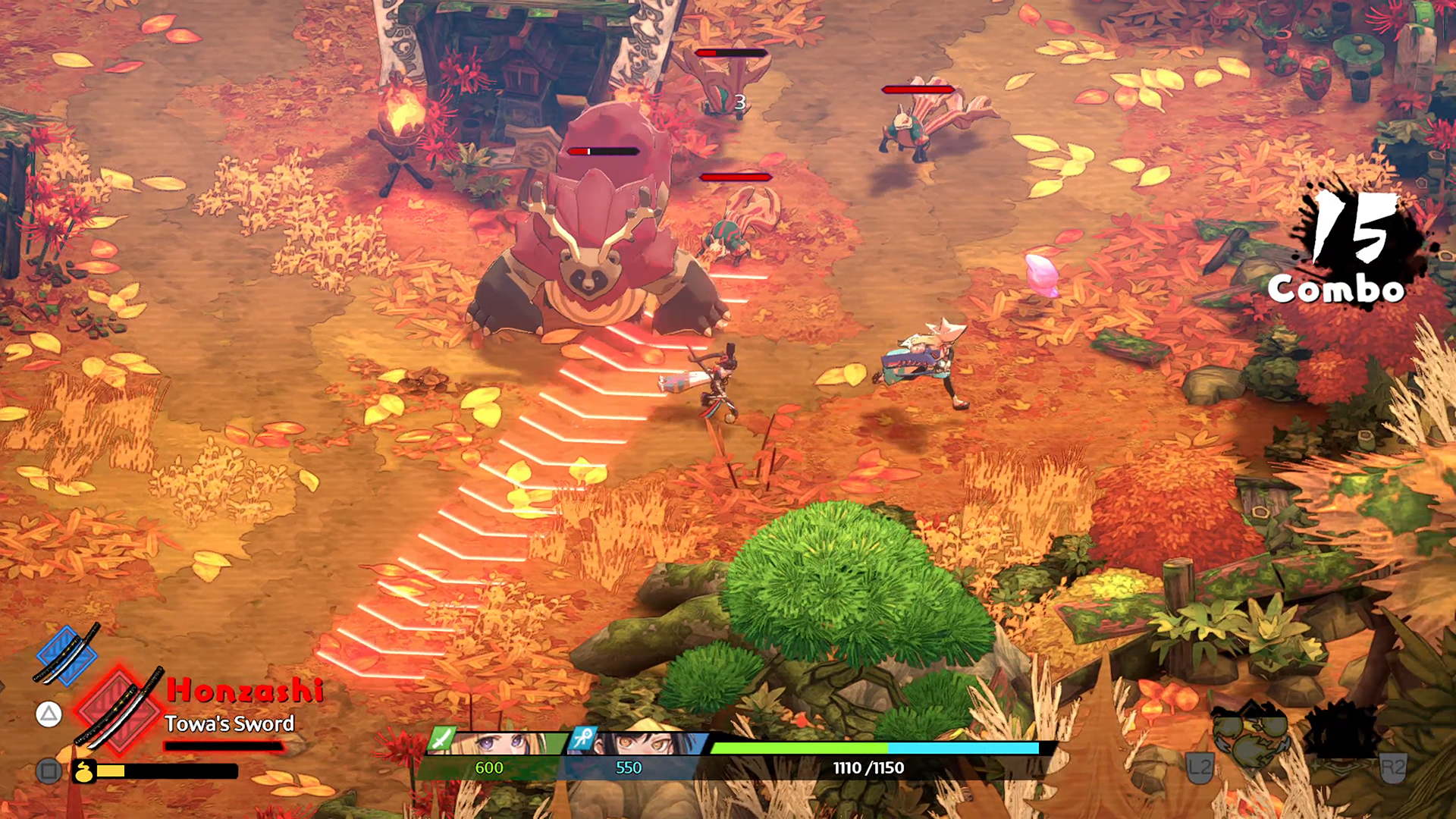
Towa, the guardian of Shinju Village, watches over the village, offering guidance and advice to the civilians without getting too involved in their personal matters. However, Magatsu is spreading his deadly miasma, causing an evil influence to overtake the lands, and is heading towards Shinju Village. To prevent this tragedy, Towa and her eight faithful guardians embark on an adventure to fend off Magatsu’s minions and deliver the final blow to Magatsu once and for all.
Before setting off on their adventure, Towa has arranged protection against the miasma for two people. You, playing as Towa in the game, will choose a Turugi and a Kagura from your eight guardians. The Turugi is your main character, with the most abilities to use, while the Kagura is your support character who will cast spells. In co-op mode, the secondary player will control the Kagura.
Each guardian has a unique combat style with a sword as the Turugi. For example, Mutsumi can send out projectiles in her special move whereas Rekka’s special attack can unleash multiple sword slashes towards a bundle of foes in front of her, cancelling their attack attempts. It’s entertaining to go through each character and test out their attacks and abilities along with their unique designs that make each one stand out. The Turugi positions will carry two swords that can wield different battle power but players must be on the lookout when their current sword’s durability is depleted. Once it does, switch to the other blade with a simple button command. Each sword will utilize a different attack pattern. If you prefer the previous attack style, you can switch it back after a second to keep using it.
As for Kagura roles, they are limited to what they can do by using two spells that require a cooldown timer before initiating another round. More spells can be unlocked by spending specific ores and you can only choose one spell from each category for your two commands. While the Kagura role doesn’t feel as important in battle, they do play a bigger role after clearing the area’s final boss. Sacrificing their life to clear the miasma, players will no longer be able to play that character again through this adventure. You’ll want to choose wisely who you want to play as the spellcaster.
That’s Teamwork
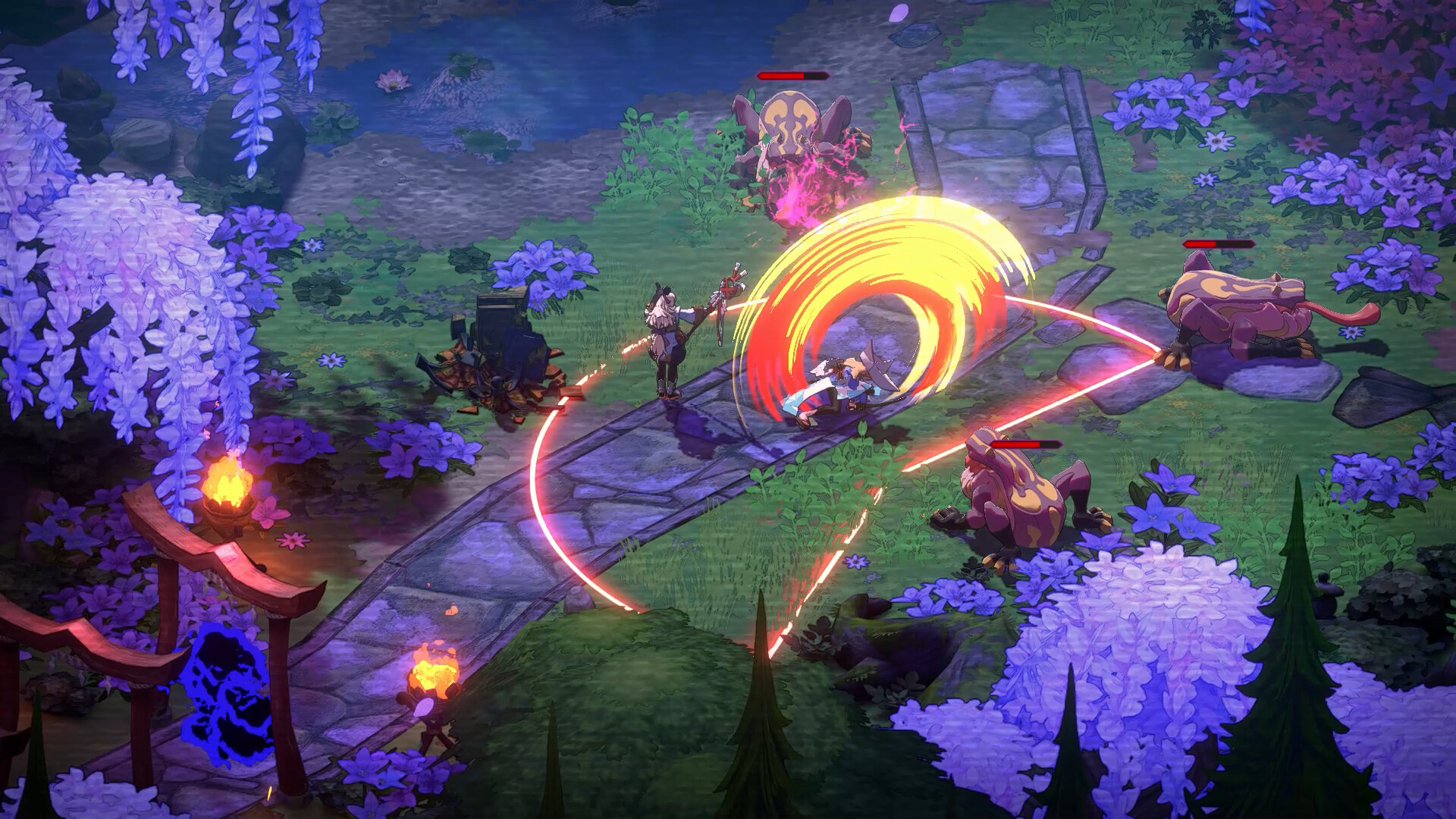
When the Kagura is played by the CPU, they stick closely to you in the middle of battle. Players have the option to control them manually, although it makes the game more challenging. During co-op, it becomes a bit tricky as players will find themselves limited in how far they can be from each other. To understand the distance limit, the game shows a red thread between the two characters. The tighter it becomes, the closer the two of you are allowed to be. This becomes a challenge when fighting bosses and trying to avoid their wide-range attacks. However, in co-op, you don’t have to worry about focusing on playing two characters, just one: the Turugi.
Whether playing solo or with a friend, if you or the other player’s health is fully depleted, you can still continue playing and fighting until the other’s health is depleted. This makes battles easier especially when you and your co-op buddy are still figuring out how to cooperate around your distance. Once both health bars are depleted, your adventure stops for now and you’re back to the village where you will have to restart your journey.
When enemies attack, they will indicate a red glow on the floor to showcase the attack range, making it easier for players to plan and avoid getting hurt. Some attacks will take a big chunk of your health if you are not careful. It is better to watch enemy patterns than to rush in and go guns blazing. Players can attack in various positions around the enemy, and attacking them from behind will result in a higher attack count than from the front. Overall, battling feels fluid, easy to understand but challenging enough to master.
Choose a Path, Reap the Rewards
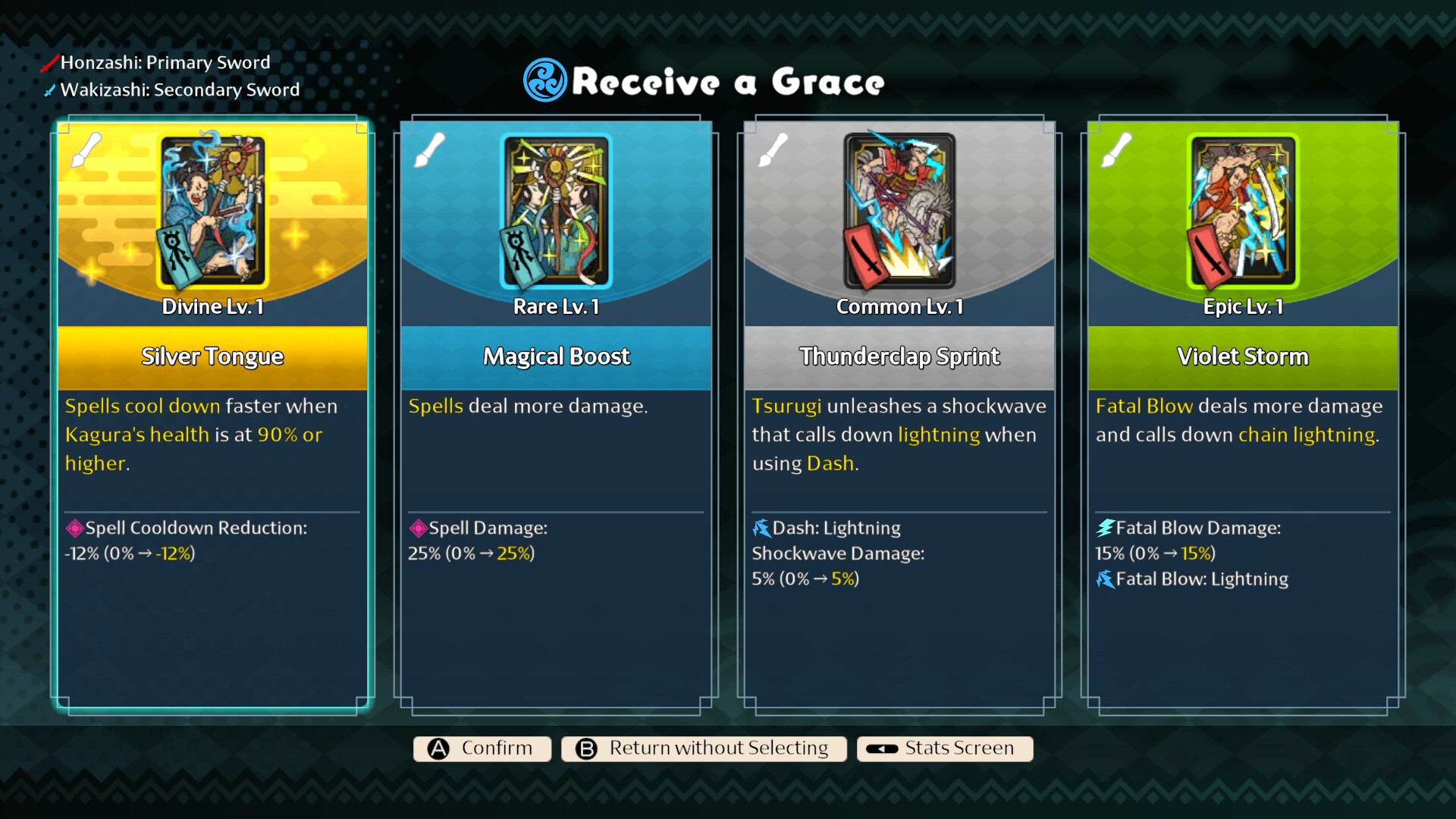
When you embark on a new journey, your small team will need to traverse a specific set of terrains before facing the big boss of the adventure you began. Each terrain has its own boss, with the last one being the toughest you will encounter. You will move through various areas, some in different directions, before reaching a boss at the end of each terrain. During your travels, players will have rest areas where they can purchase Graces, foods to increase specific stats, regain health, and settle in hot springs to gain additional stat increases.
By defeating a set of enemies or completing a task such as surviving for thirty seconds, you will be rewarded with a Grace card or ores. Grace cards can enhance your attack power, health, and cooldowns for spells. However, if you quit or both characters perish, you will lose these Graces. Players may find themselves repeating journeys multiple times, which can start to diminish their enthusiasm for repeating the same tasks over and over again. A variety of places to journey could ease this.
Ores act as currency in the game and can be used to create new items like swords or Grace jewels. There are several different types, each one used in specific ways. They can also be utilized to construct new buildings with the carpenters in the village, or to boost your team’s stats such as health and attack power. Additionally, you can earn extra ores outside of your journeys by progressing through the storyline with the villagers, fishing, or doing errands. However, it doesn’t feel enough and players will be yearning to gather more ores.
Fishing is a simple process – just cast the line and tap the button repeatedly when a fish bites. However, it becomes less exciting after catching three fish, as it takes longer to catch the next one and earn enough points to trade in for ores, which feels more like a chore.
Outside of these two mini games, there are no other mini-games to earn additional ores. This can make the game feel somewhat lacking in additional content at times. Introducing a battle arena, card games, or another way to earn rewards could enhance the game’s replay value and depth of content.
Watching Them Grow
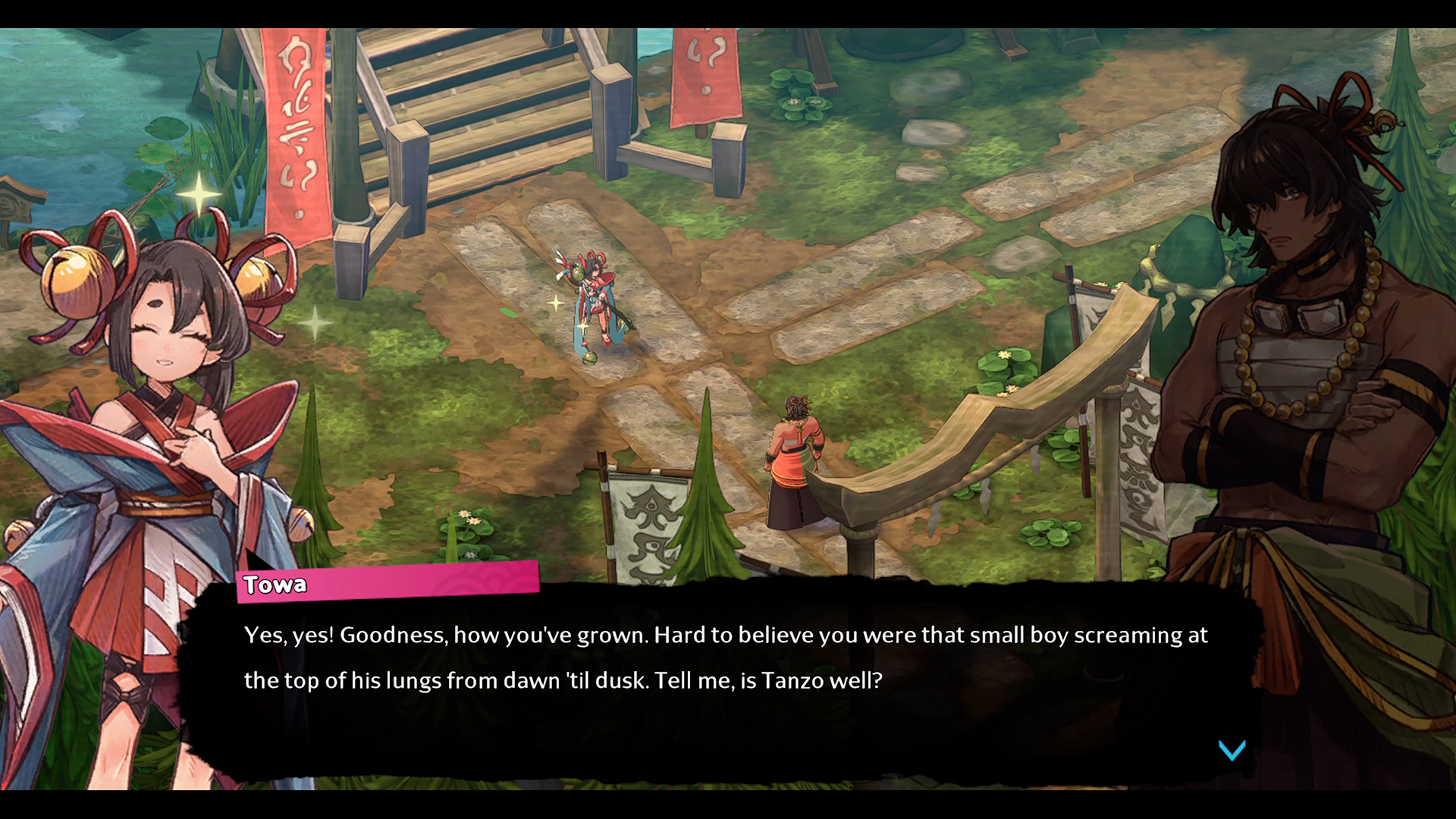
Outside of battles, you will control Towa, the guardian of the village who oversees the time periods as you progress further into the game. If the main story wasn’t enough to follow, the game is filled with various story plots between villagers which are intriguing as you see how things unfold in different time periods. Some of the children in the village grow up, while some of the adults now show their age with additional wrinkles and grey hair. In between completing journeys, you will go through various scenarios. Some of the stories may be lengthy, but fortunately, there is a skip button available. If you accidentally miss a story, the game offers a library of stories where you can go back and watch unseen dialogue scenes to earn missed ores.
Players have the option to rewind time, thanks to Towa’s ability to time travel to the past. By doing this, you will lose progress in the game’s story, building process, and completed journeys. However, any Grace jewels, ores, and stat increases you have acquired will remain untouched. Rewinding time can be useful if you want to collect additional ores in previous battles to strengthen your team.
As the stories unfold, there is a lot to take in and learn from the game’s mechanics. It may feel overwhelming at first, but as you digest it piece by piece, the game becomes addicting. Sometimes it feels like a guilty pleasure, a glutton for punishment.
Make the Perfect Sword
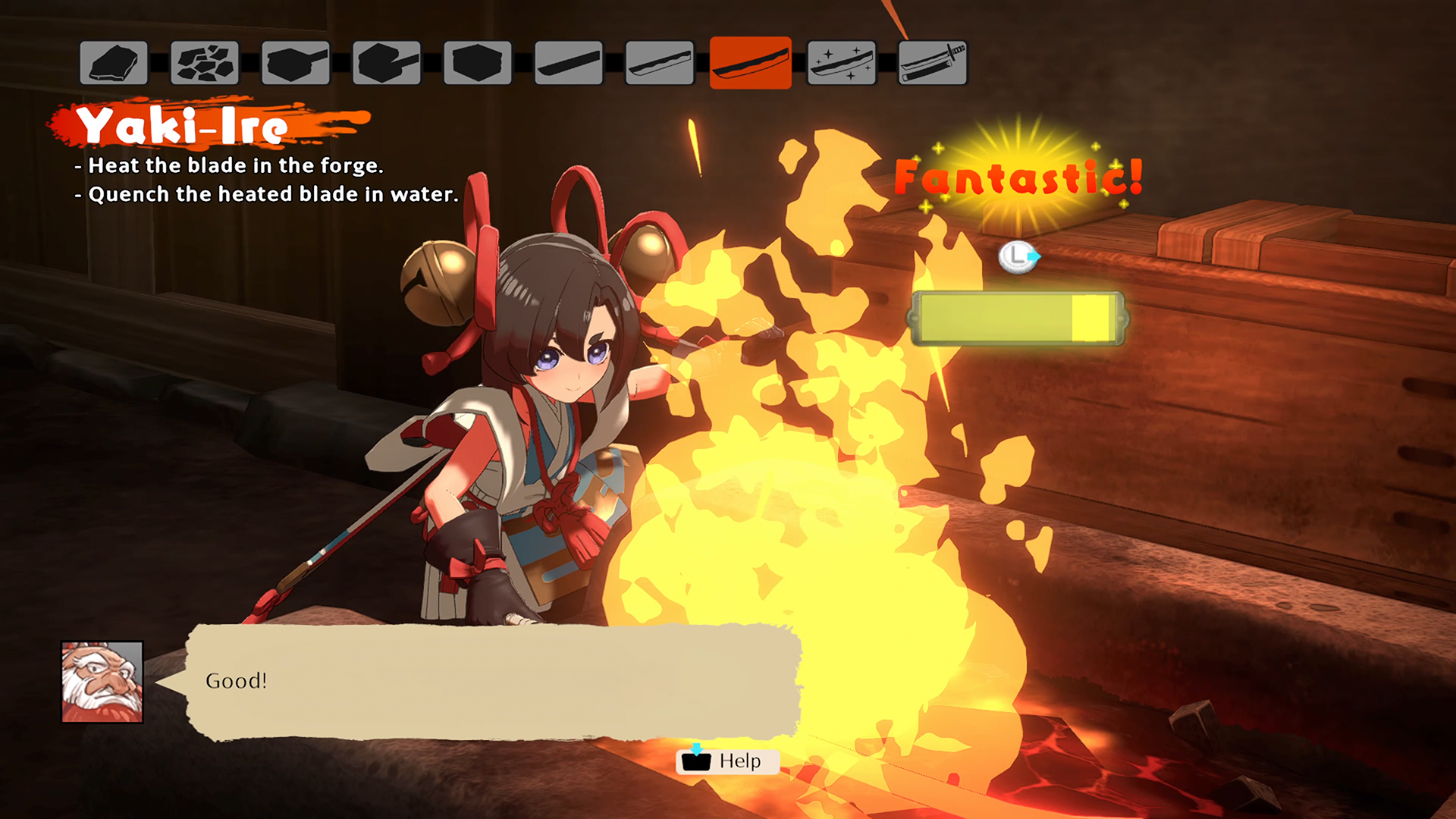
In this roguelike game, players can craft their own swords. These swords require a few items before starting. Once you begin the blacksmith process, there are several steps you’ll need to follow if you want a well-built sword. These tasks require users to pay attention to swiping the joystick to a specific colored bar; the closer you are, the stronger the results. There’s also memorizing number patterns to earn stats for your sword. Players can sharpen the blade to adjust the stats one more time before wrapping it up. In addition to the stat adjustment mini games, players can then hammer the sword’s shape to their liking, add colored clay to create custom graphics, and add a colored sheath and handle for the final touches. More color options are available at one of the villagers’ shops.
At first, the process was overwhelming, but after going through it a couple of times, it became easier to understand. There are other smith options where you don’t have to go through the mini-games of blacksmithing, but you’ll lose most of the opportunity to increase the sword’s stats and add a Grace card for additional effects.
These swords can be equipped to your Turugi or dismantled if you are unhappy with the results. If you pause the sword process during the first mini game, you can restart it to try again. Once you go further and pause the process, you will return to the current stage and not start over. If you decide to quit, you lose the materials.
That Elegant Look
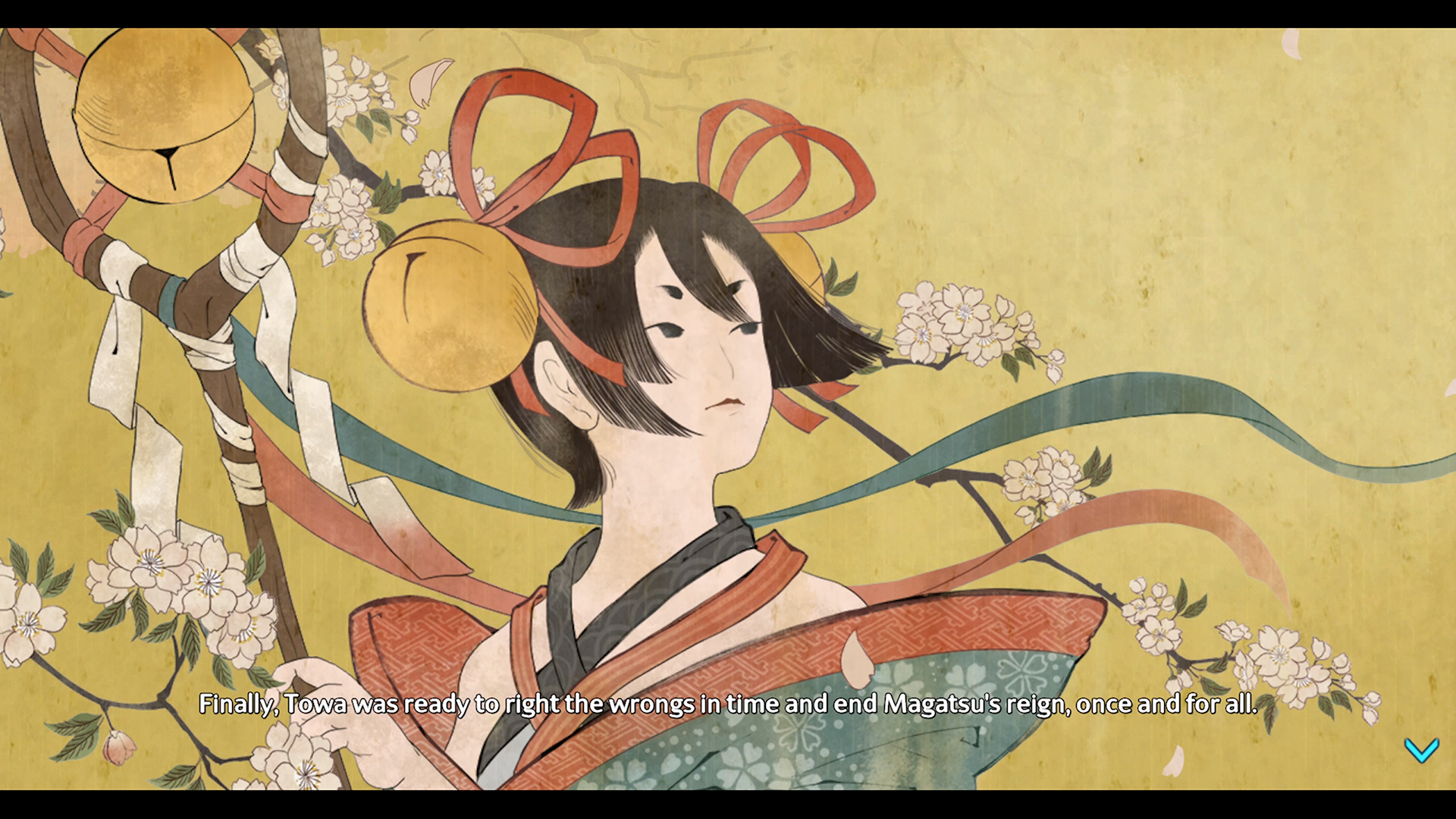
The world of Towa and the Guardians is inspired by Japanese folklore and its wood block style artwork. Using vibrant colors and heavy brushstrokes in detail, it feels like you are in a Japanese storybook. Characters are well designed, each one with a unique detail that separates from each other. Voice overs are great in both English and Japanese. The soundtrack flows smoothly while passing through the village and adds urgency during boss fights.
There are some areas, like the shrine area in the village, that appear a little dated when zoomed in, with the trees and shrine parts looking less detailed in their polygon shapes. Two-dimensional graphics, such as character illustrations that take over the screen and the graphics used in text cards during blacksmithing, are slightly out of focus, as if the resolution isn’t high enough. This becomes more noticeable when playing on a larger television with a console like the PlayStation 5. Despite these minor issues, the character illustrations and the world itself are still gorgeous.
The Final Journey
Towa and the Guardians of the Sacred Tree is filled with stunning designs and engaging entertainment that will challenge you, rewarding you with experience for the next round, even after multiple losses. Remember, if at first you don’t succeed, slash, slash again!
A PlayStation 5 review code was provided for this review. Towa and the Guardians of the Sacred Tree will launch on the Nintendo Switch, PlayStation 5, Xbox Series X/S, and PC on September 19, 2025. Fans can visit the official website for additional information and purchasing.
Related Stories
Related Posts



Leave a Reply
Subscribe
Login
0 Comments
Oldest